

Dylan Jacobs (Ezra Dewey) and his father Michael (Rob Brownstein) are trying to pick up the pieces in The Djinn. It is the fall of 1989 and a few months earlier Dylan’s mother Michelle (Tevy Poe) took her own life. Now it is Michael’s sole responsibility to raise Dylan and look out for him. Dylan has a condition where he has lost the ability to talk, communicating in sign language with those around him. He blames his condition on what drove his mother to commit suicide, a notion that Michael quickly dispels. Regardless of his father repeatedly dismissing it, Dylan can’t help but feel the pangs of guilt. That coupled with his condition have made life challenging, and he longingly watches neighborhood children playing outside.
 One fateful evening as Michael is out working a graveyard shift, Dylan is drawn to a closet where he finds the “Book of Shadows”. Almost immediately he stumbles upon the “Wish of Desire” – and wanting nothing more than to be able to speak, he performs the ritual. Unfortunately, it’s not as simple as that and the wish comes with some strings attached. Shortly after, things begin to go wrong as a dark presence known as the Djinn (John Erickson) begins terrorizing Dylan. Dylan must do all he can to survive until midnight to be able to vanquish the Djinn and receive his wish.
The Djinn is the brainchild of David Charbonier and Justin Powell who wrote and directed it together. The film has a very minimal cast and takes place entirely in one apartment. A majority of the film is Dewey trying to make it through the hour against the Djinn. A strong performance was necessary to make The Djinn work and that is exactly what we get from Dewey. He shines from beginning to end and I was incredibly impressed. Not only was Dewey the sole focus for a majority of the film, he had to carry this burden without any dialogue. The audience relied on facial expressions and body cues to convey what Dylan was thinking/feeling and Dewey portrayed this masterfully.
 Charbonier and Powell are able to establish an atmosphere of dread throughout the entire film. From exaggerated/almost hypnotic noises of Dylan’s bedroom fan to creaking doors and Dylan’s wheezing breathes – every little noise leaves you on the edge of your seat. They frame shots to just show tiny corners of rooms exposed – and you find yourself staring at them just as much as Dylan – waiting with bated breath for horrors that may be lurking.
 The Djinn has a very short runtime, just about an hour and fifteen minutes, but Charbonier and Powell take full advantage of it. There are numerous scenes that will be stuck in my mind for quite some time. They found the perfect mix of almost dead silence and loud noises mixed with spot on music choices. It is hard to stand out in the horror genre, but The Djinn manages to do so. Charbonier and Powell’s filmic choices combined with the unique elements of the monster itself set The Djinn apart. The film also has a level of heart to it that is not commonly seen in the genre. It dives deeper than scares and gets at family grief and bonding as well. The tension, scares, and acting of Dewey make The Djinn a film absolutely worth checking out.


 High Ground doesn’t take it’s sweet time to get started, opening up in 1919 on a group of British troops heading toward a tribe of Aboriginal families who don’t appear to be doing anything other then living their lives. The troops, on the other hand, are rifle in hand and moving with purpose. Among them is Travis (Simon Baker), who survived World War I as a sniper in the King’s service and appears to be the only one without direct malice in his heart. As expected, the confrontation doesn’t go peacefully and the result can only be called a massacre, with only three of the Brits left alive, Travis and two of his comrades, Eddy (Callan Mulvey) and the troop chaplain Braddock (Ryan Corr). While trying to come to terms with what he saw and was unable to stop, Travis finds an 8-year-old boy named Gutjuk hiding in the river. With no other choice, and to calm his feelings of guilt (or embrace them) Travis takes the boy with him to raise. 12 years pass when it’s discovered that troop outposts are being raided, burned to the ground, and having their inhabitants murdered. It doesn’t take long to find that they missed one survivor of the film’s opening massacre, Gutjuk’s uncle Baywara (Sean Mununggurr) who is out for revenge. The film’s main themes come into play as Travis and Gutjuk track down and attempt to stop Baywara, fully testing the loyalties and love of Gutjuk to his family and his adopted protector.
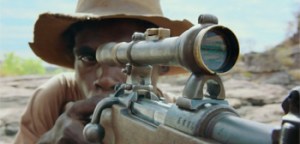 As you could probably surmise from that description the content of this film is ugly, dirty, wrong, and ugly. Perhaps that’s why it’s so surprising that the film itself is so breathtakingly beautiful. Honestly, I think the beauty of the film causes the ugliness of its content to hit home even harder. Andrew Commis, the films cinematographer, may not be a household name yet but if he keeps producing shots like he did here it won’t be long until he’s on stage holding an Oscar. For all the terrifying aspects of the Australian Outback, it’s easy to forget how beautiful of a place it can be. Baz Lurhman’s Australia is the last film I can think of that really committed the wonder of that continent to film. This isn’t to give him ALL of the credit, no, Stephen Johnson’s direction is on point as well. The sweeping vistas and long shots invoke the best of what we think of when you hear Western, with a gentle touch on the character moments that bring you into the drama unfolding.